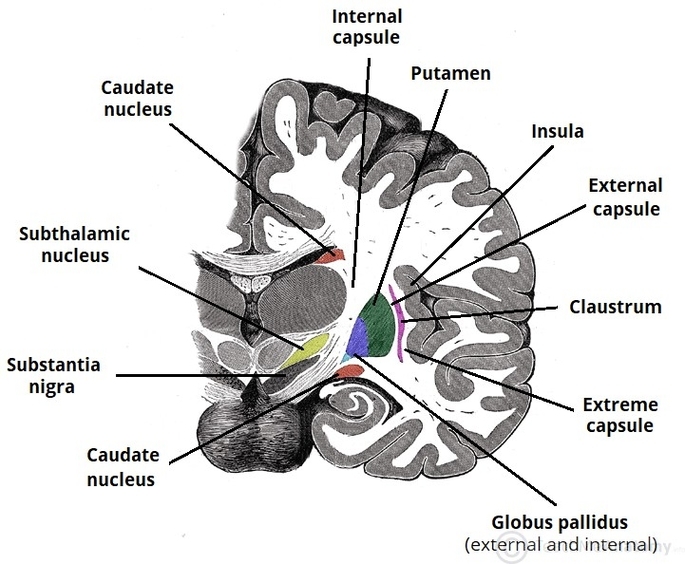
The basal ganglia consist of interconnected deep brain nuclei including the caudate nucleus, putamen, globus pallidus, subthalamic nucleus, and substantia nigra. These structures work together to regulate voluntary movement, motor planning, and habit formation by modulating signals between the cerebral cortex and thalamus. They play a key role in facilitating desired movements while inhibiting unwanted ones, allowing smooth and coordinated motor activity. Dysfunction of the basal ganglia can lead to movement disorders such as Parkinsons disease, Huntingtons disease, and dystonia, demonstrating how central this system is to everyday motor control. Components of the Basal Ganglia Diagram - Chart - diagrams and charts with labels. This diagram depicts Components of the Basal Ganglia and explains the details of Components of the Basal Ganglia.
Components of the Basal Ganglia